- The Narrative Intel
- Posts
- What Your Relationship to Time Says About You
What Your Relationship to Time Says About You
Every delay, apology, and scheduling choice tells a story to the people around you

Alan Berkson
December 21, 2025
Lately I’ve been paying attention to how often people talk about time. About running behind. About how the day “got away.” About being slammed, buried, or crazy busy.
I’m not exempt. My calendar fills up too. I run late. I regularly underestimate how long things will take. That’s part of being human — and part of operating inside systems that assume instant context-switching, infinite attention, and zero recovery time.
But the more conversations I have with founders and leaders, the more I notice something subtle and consequential: the way we talk about time becomes part of the reputation we carry. It shapes how people experience working with us. And most of us don’t realize we’re telling that story at all.
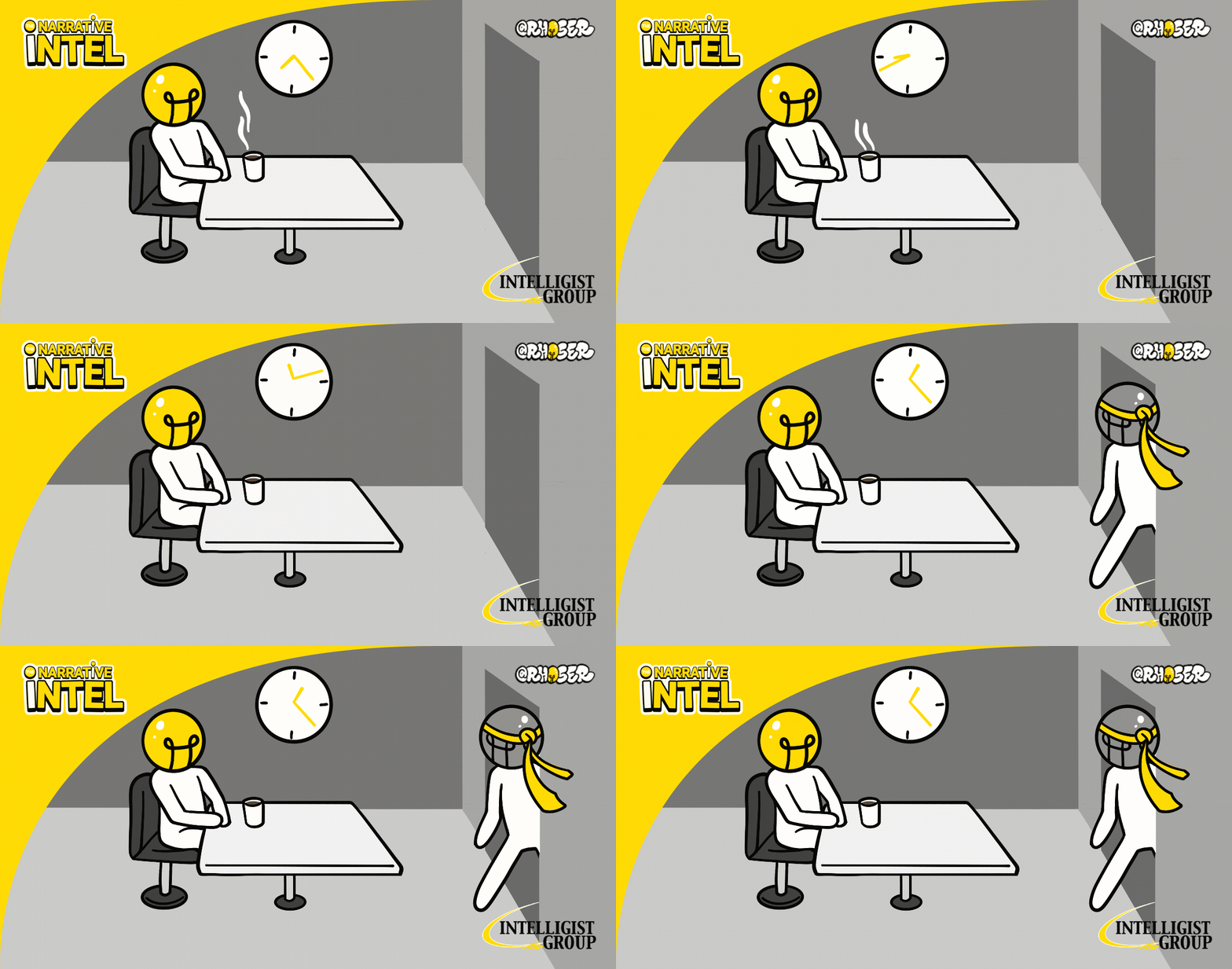
Every delay, apology, and scheduling choice tells a story to the people around you
When we say “I’m busy,” who are we actually talking to?
On the surface, it’s just an explanation. A little context. But beneath, it carries meaning. Sometimes it says, I care—I just haven’t caught my breath. Sometimes: Please understand, I’m doing my best. And sometimes it’s simply the only language we have for overwhelm.
Most people don’t use “busy” as an excuse. More often, it’s a form of self-protection—a way to stay afloat.
But the person on the receiving end never hears the backstory. They experience the pause.
Not because anyone is careless or inconsiderate, but because time is relational.
How we show up to someone else’s time quietly shapes how they experience us.
Our calendars don’t help us tell the truth.
Modern work trains us to believe meetings should fit together neatly: top of the hour, bottom of the hour, thirty minutes here, fifteen minutes there, stacked back-to-back until the day disappears. It creates the illusion that we can transition instantly, endlessly.
If you’ve ever missed a meeting scheduled for fifteen minutes past the hour, I understand.I’ve done it too. My brain no longer expects time to have that kind of nuance.
Most of us aren’t late because we don’t respect other people. We’re late because we’re operating inside systems optimized for efficiency, not reality. Leadership isn’t about perfect punctuality or rigid control. It’s about how we enter—and exit—the time we share.
Over the years, I’ve adopted one small habit that has quietly changed how I think about this. Instead of saying, “Sorry I’m late,” I say, “Thank you for waiting.”
It’s a subtle shift, but it moves the emotional center of the moment. “Sorry I’m late” centers my shortfall. “Thank you for waiting” acknowledges the other person’s generosity —the attention, presence, and patience they extended.
It also reminds me, gently, that time is a gift. Not a default.
Berkson’s Bits…
Just because something worked for someone else doesn't mean it will work for you.
The more useful question is why it worked for them. What conditions made it possible. What constraints shaped the outcome.
Only then can you decide whether those conditions exist in your own context—or whether you’re trying to borrow a result without understanding the system that produced it.
What I’m Watching…
All In The Family, The Princess Bride, Spinal Tap, A Few Good Men, The American President, The Bucket List, When Harry Met Sally...
RIP Rob Reiner.
When people talk about leadership presence, they usually mean tone, clarity, or confidence. In practice, what people register is simpler. They notice whether you make space for them. Whether you close loops. Whether your time has room for theirs.
That’s narrative. Not the story you tell, but the one people live with.
Your relationship to time is one of the clearest, quietest signals of how you lead. Not because you’re perfectly punctual or endlessly available, but because you’re intentional. Because you see the other person. Because you respect their bandwidth as much as your own. Because you use time as a way to communicate care.
In a world where everyone is stretched, scattered, and slightly overbooked, this may be one of the strongest cues people use to decide how it feels to work with you.
Thank you for the time you take to read this.
Looking forward to continuing the conversation...
Alan
Reply